


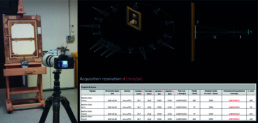
Digitizing the Barberini Collection Canvases: Guidelines, Protocols, and Quality Parameters
ABSTRACT
The paper presents an ongoing experiment aimed at defining a protocol for the digitisation of the canvases belonging to the collections of the Galleria Nazionale d’Arte Antica at Palazzo Barberini in Rome. The experiment has been developed within the framework of the project MUSE – MUseum management, enhancement and accessibility: a Sustainable digital Ecosystem of interactive digital collections, oriented towards the definition and validation of a methodological and procedural protocol for the prototypical creation of an interactive ecosystem of digital models of the collections and of the museum itself. Within this context, the issue of digitisation has been addressed in relation to the meanings associated with the concept of the digital twin, with particular attention paid to the role assumed by the digital copy within the processes of constructing the twin itself. The research has emphasised the qualitative parameters and attributes of the digital copy, understood as indicators of reliability, with reference to the regulatory framework outlined by the National Plan for the Digitisation of Cultural Heritage (PND) and its related Guidelines. The experiment concerned a sample of canvases, on which photogrammetric and high-definition photographic acquisition methodologies at controlled resolution were tested, with the aim of defining digital copies based on principles of data neutrality and process transparency.
Alessandra Meschini, Jessica Romor, Marta Salvatore
Dipartimento di Storia Disegno e Restauro dell’architettura, Sapienza Università di Roma
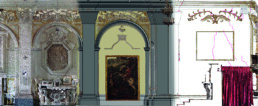
AI/H-BIM workflow to digitize and analyze structural damage
ABSTRACT
This paper presents an ongoing experimental study aimed at integrating H-BIM and Artificial Intelligence for the digitalisation and structural damage assessment of masonry churches, in support of conservation and heritage management activities. The proposed approach involves the semantic modelling of the building through its decomposition into Macro-Elements, in accordance with traditional methodologies for seismic damage evaluation. The case study under investigation is the Church of the Compagnia della Disciplina della Santa Croce, located in the historic heart of the Forcella district in Naples. The H-BIM model, developed from reality-based surveys following Scan-to-BIM principles, is enriched with information related to the crack pattern, semi-automatically mapped using convolutional neural networks. This integration enables a shift beyond purely descriptive approaches, guiding the process towards a semi-automatic evaluation of the damage index and contributing to the development of interoperable information systems for the preventive management of cultural heritage.
Arianna Lo Pilato, Simona Scandurra, Federica Itri, Laura Simona Pappalardo, Daniela Palomba, Antonella di Luggo
DiARC, Università degli Studi di Napoli Federico II
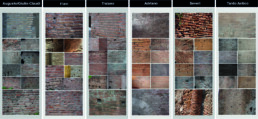
Structure and Methodology for Building a Dataset of Images of Roman Brick Masonry
ABSTRACT
This contribution presents the construction of a dataset of images of Opus Testaceum masonry walls, structured to train supervised classification models. A total of 24 representative buildings were selected, distributed across the 14 Regions of Augustan Rome and referring to six main construction phases between the 1st and 4th centuries AD. The photographic survey produced approximately 2,400 images, varied in lighting and angle, to capture the morphological and material diversity of the masonry. The dataset is designed to test the model’s ability to generalize classification to previously unseen buildings and will be made available in open access for the benefit of the scientific community. The project also aims to foster a dialogue between the humanities and computer science, emphasizing the active role of Archaeologists and Architects in shaping innovative digital tools for the analysis, understanding, and interpretation of Cultural Heritage.
Martina Empler
Dipartimento di Scienze dell’Antichità. Sapienza Università di Roma
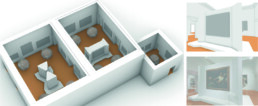
Spherical panoramas for the visual implementation of BIM models in museums
ABSTRACT
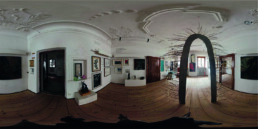
The contribution describes a methodology for the integration of spherical panoramas in BIM models, with the aim of improving the visualisation and use of museum spaces. The procedure is based on topographic surveys, Structure from Motion processes and digitised alignment algorithms.
Michele Calvano, Graziano Mario Valenti, Arianna Moretti, Talin Talin
Dipartimento di Storia, Disegno e Restauro dell’Architettura. Sapienza Università di Roma
3D modeling of cultural spaces using Artificial Intelligence: from rapid and low resolution video capture to high performance reconstruction
ABSTRACT
This research explores the use of low-resolution monocular and 360° video for 3D reconstruction in the context of cultural heritage documentation. The proposed methodology relies on GLOMAP, an efficient global Structure-from-Motion pipeline, to generate sparse point clouds from consumer-grade video data. To enhance the visual quality and address limitations due to low resolution and incomplete depth information, the workflow integrates Artificial Intelligence techniques, specifically Neural Radiance Fields and 3D Gaussian Splatting. These methods improve texture continuity, reduce visual artifacts, and provide photorealistic rendering capabilities, even in challenging conditions such as the data examined. The pipeline was tested on real-world case studies in South Tyrol, including architectural documentation, rapid surveying of temporary museum exhibits, and immersive environment creation for educational videogames. The results demonstrate that while laser scanning and traditional photogrammetry remain more metrically accurate, the proposed solution offers a fast, cost-effective, and visually convincing alternative, especially suitable for dissemination and interactive applications. Challenges related to geometric precision and computational cost were identified, suggesting future research directions aimed at optimizing AI integration and depth estimation. Overall, this work highlights the potential of combining SfM and neural rendering for accessible and scalable heritage digitization.
Francesca Condorelli
Libera Università di Bolzano
Beyond the Line: Between Stylistic Learning and Controlled Generation with Stable Diffusion
ABSTRACT
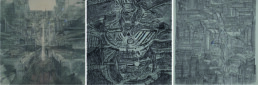
The article presents an experiment on the use of generative artificial intelligence for stylistic transposition in architectural drawing, investigating the potential of diffusion-based models in learning authorial graphic languages. Through a protocol based on the fine-tuning of Stable Diffusion 1.5 via DreamBooth, three distinct models were trained on visual datasets dedicated to Paolo Portoghesi, Ludwig Mies van der Rohe, and Le Corbusier. The selected drawings allowed the model to internalize a pure stylistic code, based on strokes, compositional syntax, and graphic geometry. Controlled generation was carried out through a nodal pipeline in ComfyUI, with the integration of ControlNet for structural control. The qualitative analysis of the outputs highlighted coherent yet non-imitative generative behaviors: decorative amplification for Portoghesi, geometric rarefaction for Mies, plastic-chromatic variation for Le Corbusier. The results demonstrate that AI can operate not only as an executive tool but as a critical and interpretative agent capable of revealing the latent structures of architectural style. The research opens methodological and applicative perspectives for the construction of digital repertoires, educational tools, and unprecedented forms of computational representation.
Fabio Bianconi, Marco Filippucci, Andrea Migliosi, Chiara Mommi
Dipartimento di Ingegneria Civile e Ambientale, Università degli Studi di Perugia
Index Volume 15
INDEX
Editorial
M. Lo Turco, A. Luigini
A New Interface for the Museum Cultural Experience: Gamification and Websites
J. Bono
HBIM and Visual Programming: data management for historic heritage preservation
M. Cozzali, F. Bianconi, M. Filippucci
Digital Landscapes and multi-scalar representations to rediscover the fortified system of Verona
F. Galasso
In the Apulian furrows. A picturesque adventure through the engravings of the Grand Tour
P. Micelli
Reconstruction of the Necropolis area related to the Triclinium Tomb and design of a virtual tour
S. Ridolfi
ARound Murgia: transmedia dissemination approaches for the Alta Murgia National Park
A. Caldarone
A new interface for museum cultural experience: gamification and websites
ABSTRACT
In a context characterized by the increasing fusion of information technologies and the cultural sector, cultural institutions like museums must adopt digital methods and tools capable of interpreting and embracing this change by creating new experiences. Today, museums also compete with new forms of entertainment, with gamification experiences standing out in particular.
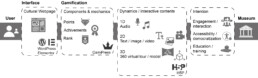
In response to this transition, museums are adopting this new ‘medium’ to rethink how they engage with their audiences. This contribution focuses on using and integrating gamification techniques within museum webpages, creating an interface that enables the museum website to become a valid educational and community platform. This interface enhances user engagement and increases loyalty through points, badges, and leaderboards. It encourages users to repeat the experience, improve their performance, extend navigation time, and stimulate user-generated content. The exploration of these new dynamics is applied to the Pinacoteca Albertina website, specifically the exhibition ‘Neoclassicism in Turin. From the 18th century to the young Antonelli’. Previously, the research team carried out a digital and immersive reconstruction of the visionary project for the Turin Cathedral. The described experience represents the completion of a broader initiative aimed at improving the accessibility and interactivity of the exhibited collection using web-based gamification techniques.
Jacopo Bono
Dipartimento di Architettura e Design (DAD) - Politecnico di Torino
HBIM and Visual Programming: data management for heritage preservation
ABSTRACT
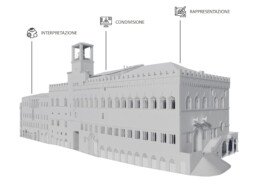
The research investigates how HBIM, integrated with Visual Programming tools, improves data management for heritage conservation. The digital model centralizes heterogeneous information, optimizing monitoring and maintenance processes. The use of Dynamo automates data processing and export, promoting interoperability. The case study of the Library of the National Gallery of Umbria demonstrates the effectiveness of the method for sustainable and dynamic management.
Matilde Cozzali, Fabio Bianconi, Marco Filippucci
Università degli Studi di Perugia, Dipartimento di Ingegneria Civile e Ambientale
Digital Landscapes and multi-scalar representations to rediscover the fortified system of Verona
ABSTRACT
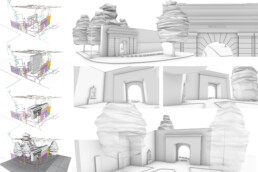
The paper explores methods of multiscalar digital representation of the fortified system of Verona, highlighting the importance of an approach capable of combining high resolution metric data with the construction of a coherent narrative of the cultural landscape in digital space. The walls and bastions that frame cities represent the connective tissue of urban identity, integrating within them traces of history, social dynamics and architectural values, transforming from a defensive structure to a living, stratified cultural symbol. The adoption of surveying techniques to document fortified structures has generated an extremely dense but difficult to manage database. Research has introduced processes of discretization and definition of levels of detail, modulating the density of information in relation to the purposes of analysis and dissemination. This choice encouraged the recomposition of the wall system through a three-dimensional model, where simplification proves to be an added value. The multiscalar model becomes a narrative and management device, a link between technical data and cultural interpretation, capable of guiding future documentation campaigns that will be conducted in the area. The results achieved to date by the Verona Città Murata project, the result of the collaboration between the Municipality of Verona and the University of Pavia, reveal how the transition from reality-based data to digital representation marks a methodological transformation that renews the way in which the fortified heritage is interpreted and enhanced.
Francesca Galasso
Department of Civil Engineering and Architecture, University of Pavia