


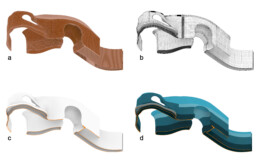
Massive wood design – From complex shape to efficient construction
ABSTRACT
The relationship between complex form and manufacturing efficiency is increasingly important in light of the remarkable development of digital manufacturing techniques. Algorithmic modelling has assumed a central role as it is able to satisfy both aesthetic and production needs.
Michele Calvano, Consiglio Nazionale delle Ricerche - Istituto di Scienze del Patrimonio Culturale;
Matteo Flavio Mancini, Università degli Studi di Roma Tre – Dipartimento di Architettura;
e-mail: michele.calvano@ispc.cnr.it; matteoflavio.mancini@uniroma3.it
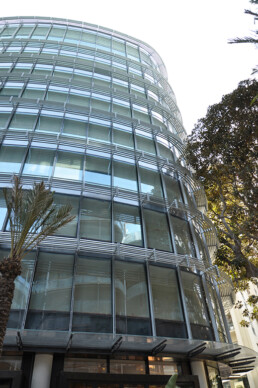
Future façades: parametric methodologies for the executive design
ABSTRACT
The application of parametric software for the executive design of future façades is oriented to structure the project reality and develop communication tools for the production and construction phases, according to an adequate representation of the complexity of contents.
Paola Vescovi
Politecnico di Milano, Material Balance Research + Engineering, Dipartimento di architettura, ingegneria delle costruzioni e ambiente costruito
e-mail: paola.vescovi@mail.polimi.it
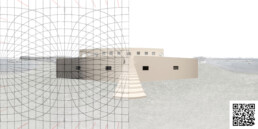
Virtual Reality for autism: a new proposal of visual frameworks for communication of the heritage and inclusion
ABSTRACT
Some positive results in experience using VR for Autism show potential for inclusion and communication with the aim to achieve a communicative instrument useful for all. Compared to the previous researches this study focuses on the human answers to technology finding new design guidelines for an autism friendly VR.
Anna Lisa Pecora
Università di Napoli Federico II
e-mail: annalisa.pecora@unina.it
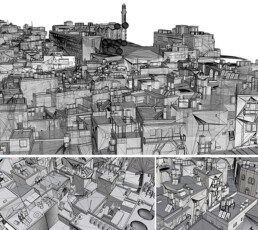
An urban modeling protocol through catalogues and technological modules. From digital survey to the 3D information system for the historic center of Bethlehem.
ABSTRACT
The three-dimensional modelling, aimed at the representation of urban contexts, is closely linked to the theme of communicating information related to the constructive, typological and technological characteristics of the historic city. In particular, the definition of methodological protocols for the creation of extended 3D models is at the center of the research developed in Bethlehem by DAda-LAB Didactics and Research Laboratory of University of Pavia.
Sandro Parrinello, Raffaella De Marco, Francesca Galasso
DICAr, Dipartimento di Ingegneria Civile e Architettura, Università degli Studi di Pavia.
e-mail: sandro.parrinello@unipv.it, raffaella.demarco@unipv.it, francesca.galasso@unipv.it
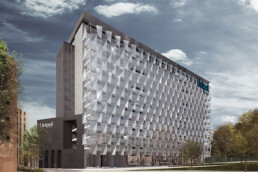
Validation processes for large BIM projects. The case of the De Castillia 23 building
ABSTRACT
The analysis of an exemplary case study is the pretext to critically examine the validation procedures of BIM- oriented projects of considerable complexity, through the description of operational strategies that allow to control and preserve the quality of reusable graphic-alphanumeric attributes even during the life cycle of the product.
Massimiliano Lo Turco, Andrea Tomalini
Politecnico di Torino, Dipartimento di Architettura e Design
e-mail: massimiliano.loturco@polito.it, andrea.tomalini@polito.it
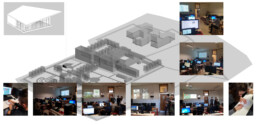
Bim level of education: a possible aproach
ABSTRACT
The current situation of AECO sector is challenging Universities in bridging the gap between skills required from the market and current qualified capabilities of young professionals. The real innovation is in the definition of new rules both for teaching and evaluating, considering the importance of new evaluation criteria and focusing on the digital value of education.
Christian Florian, BIM Manager di Permasteelisa S.p.A.
e-mail: c.florian@permasteelisagroup.com
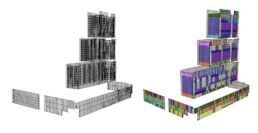
Still talking about BIM. Reflections drawn from experiences working on bespoke facades projects
ABSTRACT
Dealing with processes, digital tools and their application in the design and construction of a building means working with many acronyms that identify micro or macro-topics, areas or disciplines and at the same time, perhaps for their very nature, that generate various interpretations and some misunderstandings.
One of the first and most important acronyms, widely spread in the 1980s and then discussed for more than twenty years, is the acronym CAD and its intrinsic dualism between Computer Aided Drafting and Computer Aided Design. This dualism – which can be considered outdated as well as unsolved – was interpreted as Computer Aided Architectural Design (CAAD) and Computer Aided Design and Drafting (CADD) depending to different authors and contexts.
The most recent and popular acronym is BIM (Building Information Modeling). Depending on the context, it can be understood at the same time as a process, as a set of digital tools or as the result of both. In BIM there are many other acronyms subject to interpretations. Just to make an example: LOD (Level of Development) vs. LoMD (Level of Model Definition) that is the integration of LoD (Level of Detail) and LoI (Level of Information). Both now should migrate to LoIN (Level of Information Need). The term “Level” is often used in various ways and it is sometimes misunderstood.
It is what it is.
This trend will pass as many others and we will have clearer ideas in a few years…
This article does not propose definitions, which would stratify uselessly on others and could be the starting point for others again. It does not even intend to provide clarifications on the “BIM thing” which is in continuous transformation.
In this article, the word BIM will appear using italics, and telling what the author learned in recent years, addressing the digitization of information in the processes of design and construction of bespoke facades, built internationally, in very different markets.
Christian Florian, BIM Manager di Permasteelisa S.p.A.
e-mail: c.florian@permasteelisagroup.com
Index Volume 5
INDEX
EDITORIAL
Cettina Santagati, Sandro Parrinello
VPL FOR HBIM LOI ADVANCED APPS
Stefano Brusaporci, Pamela Maiezza, Alessandra Tata
HS – BIM: HISTORICAL SENTIENT – BUILDING INFORMATION MODEL
Federico Mario La Russa
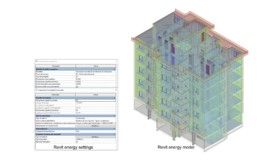
THE INFLUENCE OF THE CONTEXT ON THE ENERGY EFFICIENCY OF A BUILDING, SIMULATED THROUGH A BIM ANALYTICAL MODEL
Alessia Maiolatesi, Alessandro Prada, Paolo Baggio
GAME ENGINE AS HBIM PROPOSAL FOR SMARTPHONE IMMERSIVE VISUALIZATION. THE CASE OF THE ROMAN THEATRE IN SAGUNTO.
Cos-Gayon López Fernando, Cordón Llácer Joan, Anquela Julián Ana Belén
SEMANTIC WEB AND SEISMIC RISK: BEYOND BIM FOR PREVENTION
Adriana Caldarone
SHAPING THE PAST. THE EXPLICIT DIGITAL DRAWING FOR THE DESCRIPTION OF THE ANCIENT ARCHITECTURES
Michele Calvano, Francesca Guadagnoli

To BIM or not to BIM - Editorial Vol. 05
Magazine’s fifth issue analyzes the parametric modeling procedures aimed at the analysis, knowledge and management of cultural heritage through description of case studies and research that propose application examples regarding parametric databases for the documentation of historical heritage. Construction of digital archives, starting from 3D surveys, associated with dynamic, semantic and parametric three-dimensional models, for a protection of the historical architectural heritage, qualifies the development of analysis tools that exploit three-dimensional modeling and technologies for data visualization and management of the complexity of historical heritage.
Different applications of BIM platforms on historical heritage require a reflection on the quality of models that must be able to describe deformations and irregularities of the built architecture. Ability to write down information on models regarding the state of conservation and the performance of a “building machine” in terms of systems and technological infrastructures constitutes one of the most relevant topics and themes regarding the use of these tools in management of buildings.
The sequence of articles proposes an in-depth study of this issue’s subject by addressing various experiments and variations of the parametric models created.
Contribution of Stefano Brusaporci, Pamela Maiezza and Alessandra Tata, entitled VPL for HBIM LOI advanced apps, is focused on the interoperable implementation of H-BIM database with historical news through the use of VPLs.
Federico Mario La Russa’s article about HS-BIM: Historical Sentient – Building Information Modelsproposes a decision support system starting from HBIM based on artificial intelligence mechanisms in which the model is able to “perceive” stimuli and “propose” solutions related to its management and conservation. Relationship between development of an energy simulation model starting from a three-dimensional BIM prototype is addressed in Alessia Maiolatesi, Alessandro Prada and Paolo Baggio’s text about the influence of context on a building’s energy efficiency, simulated through a BIM analytical model.
Game engine and solutions for the use of heritage through smartphones and immersive systems is an interesting aspect for the convergence of development activities. Case study of Roman theater of Sagunto described by Fernando Cos-Gayon López, Joan Cordón Llácer and Ana Belén Anquela Julián describes this possibility of synergy between information systems with pre-eminently technical purposes and possible developments for dissemination processes.
Still with regard to construction of an archive for heritage’s protection with possibility of building a platform on the web, is Adriana Caldarone’s article (Semantic web and seismic risk: beyond the bim for prevention) which deals with knowledge process for seismic risk prevention in resettlements and is aimed at a global understanding of material and immaterial values underlying the training processes of fabrics and building agglomerations. The experience reported by Michele Calvano and Francesca Guadagnoli in contribution Shaping the past. The explicit digital drawing for the description of the ancient architecturesdescribes the experimentation carried out in the archaeological field of parametric modeling through VPL on the Neolithic settlement of La Draga (Girona, Spain).
Sandro Parrinello, Cettina Santagati

SHAPING THE PAST. The explicit digital drawing for the description of the ancient architectures
ABSTRACT
The research aims to describe a positive match between contemporary digital representation techniques and the discipline of archaeology. Specifically, it refers to the experience resulting from the collaboration between the discipline of drawing and the group of archaeologists based at the Universitat Autònoma de Barcelona [1]. The subject represented through parametric modeling for architecture was the Neolithic settlement of La Draga (Girona, Spain).
Michele Calvano, Politecnico di Torino, michele.calvano@polito.it
Francesca Guadagnoli, Sapienza, francesca.guadagnoli@uniroma1.com