


The influence of the context on the energy efficiency of a building, simulated through a BIM analytical model
ABSTRACT
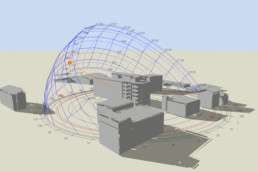
The research presented describes the development of an energy simulation model of an existing building and its environmental context, starting from a three-dimensional BIM prototype. Through the parametric analytical model, subsequently converted into a dynamic energy simulation model, the influence of environmental conditions is assessed in relation to the energy efficiency of the considered building.
Alessia Maiolatesi, Alessandro Prada, Paolo Baggio
Università diTrento. DICAM (Dipartimento di Ingegneria Civile, Ambientale e Meccanica)

HS – BIM: Historical Sentient – Building Information Model
ABSTRACT
This research aims to demonstrate how it is possible, starting from a H-BIM model, to develop a decision support system based on Artificial Intelligence in which the model is able to “perceive” inputs and to “propose” solutions related to its management and conservation.
Federico Mario La Russa
Università degli Studi di Catania - DICAR

Game engine as HBIM proposal for smartphone immersive visualization. The case of the roman theatre in Sagunto (Valencia, Spagna).
ABSTRACT
L’evoluzione del BIM può essere descritta come l’implementazione di un modello di informazioni nella realtà virtuale. Questa comunicazione si concentra sui flussi di lavoro specifici generati durante l’intero processo, dalla raccolta dei dati al modello interattivo finale, che consente all’utente di ottenere informazioni da qualsiasi elemento del modello. Questo lavoro è stato sviluppato in collaborazione con la Direzione per i beni culturali della Generalitat Valenciana. L’obiettivo principale del caso di studio è lo sviluppo di un’applicazione per tour di realtà virtuale tramite piattaforme HMD Smartphone nel Teatro Romano di Sagunto. Il software utilizzato per lo sviluppo di app è comunemente utilizzato nel settore dello sviluppo di videogiochi. Inoltre, il software Leica Truview © ha consentito un utilizzo scientifico della raccolta di dati mediante scanner e fotografia, per rafforzare lo studio archeologico e architettonico del monumento e la gestione del suo patrimonio attraverso la catalogazione virtuale.
Cos-Gayon López Fernando, Cordón Llácer Joan, Anquela Julián Ana Belén
Universitat Politècnica de València

Semantic web and seismic risk: beyond BIM for prevention
ABSTRACT
The process of knowledge for the prevention of seismic risk in settlements is aimed at the global understanding of the material and immaterial values underlying the urban fabric’s aggregative processes.The resulting data are rather varied and complex, as well as with heterogeneous formats, so they need a virtuous systematization to be suitable for the exchange of information between the figures involved in prevention activities. In response to these needs, the workflow proposed intends to exploit the qualities of relational databases, and in particular of BIM systems, where parametric models, interconnected according to constructive and ontological rules, are containers of related information, which succeed in to describe, more or less completely, the architectural organisms through the semantic decomposition of the elements that constitute them. However, the limits imposed by current software, especially those concerning the type of information that you can associate with digital objects, impose the need to implement existing procedures through the potential of other systems (VPL and semantic web), thanks to which conjugate complex form’s modeling with the semantic recognizability of the elements and a high Level of Information. The workflow proposed here has as its output a complex hyper-model, which becomes the basis for the development of effective strategies for the prevention and preservation of the vital components of urban centers at risk.
Adriana Caldarone
Dipartimento di Storia, Disegno e Restauro dell'Architettura, Sapienza Università di Roma

VPL for HBIM LOI advanced Apps
ABSTRACT
The HBIM processes require the management of many heterogeneous information, such as historical ones, usually not supported by the apps available on the market. The paper presents the interoperable expansion of the HBIM database through the use of visual programming.
Stefano Brusaporci, Pamela Maiezza, Alessandra Tata
Università dell'Aquila
Reviewer 2019
REVIEWER 2019
Fabio Bianconi, Università di Perugia, Italy
Stefano Brusaporci, Università dell’Aquila, Italy
Michele Calvano, Politecnico di Torino, Italy
Marco Carpiceci, Sapienza Università di Roma, Italy
Domenico D’Uva, Politecnico di Milano, Italy
Marco Filippucci, Università di Perugia, Italy
Elena Gigliarelli, Itabc-CNR, Italy
Carlo Inglese, Sapienza Università di Roma, Italy
Alfonso Ippolito, Sapienza Università di Roma, Italy
Alessandro Luigini, Università di Bolzano, Italy
Giovanna Massari, Università di Trento, Italy
Ivan Paduano, Sapienza Università di Roma, Italy
Leonardo Paris, Sapienza Università di Roma, Italy
Alberto Raimondi, Università Roma Tre, Italy
Michele Russo, Sapienza Università di Roma, Italy
Mario Sacco, BBIM Expert, Italy
Alberto Sdegno, Università di Trieste, Italy
Valeria Zacchei, PhD BBIM Expert, Italy

Index Volume 4
INDEX
Editorial
Tommaso Empler
BIM-based collaborative process for Facility Management
Andrea Barbero, Francesca Maria Ugliotti, Matteo Del Giudice
BIM model for enhanching modern architecture. Olivetti’s case
Sara Conte, Michela Rossi
Parametric modelling for energy retrofitting of existing building. Two possible strategies
Fabio Luce
BIM and technical management of the built
Alessandro Sepe, Andrea Tiveron
BIM for the management of cultural heritage maintenance and restoration programs
Elena D’Angelo, Federica Marini, Paola Morrone, Andrea Natalucci, Alessandra Ponzetta
Computational design for diffused historical heritage. Genotypic aspects and theoretical foundations
Maria Laura Rossi
Style issues. The relationships between photography, cinema and CG film
in 3D visualization
Cristian Farinella

Editorial Vol. 4
The fourth issue of the magazine aims to analyze the state of the art of professional practice and research activities a year after the issuing of the D.M. 560/17, which establishes methods and timing for the progressive introduction of electronic modeling methods and tools for the building and infrastructure sectors, making obligatory specific electronic methods and tools for complex works related to tender base amount mandatory ≥ 100 million euros.
Different forms of BIM-oriented systems constitute the object of investigation, highlighting the ways in which these issues, with their apparently purely technical or technological connotations, can instead have multiple application derivatives, creating new areas of interest for researchers, experts, operators and professionals.
BIM approach is, by its nature, three-dimensional, enriched and implemented by informative variables and parameters which, based on different contexts, needs and different application scenarios, can be characterized by many deeply interdisciplinary branches. A good example are studies and analyzes on contemporary architecture; applications related to energy sustainability; analyzes and processes applied to Facility Management.
This is the direction of the papers of Andrea Barbero, Francesca Maria Ugliotti and Matteo Del Giudice with BIM-based collaborative process for Facility Management, Sara Conte and Michela Rossi with BIM model for enhanching modern architecture. Olivetti’s case, Fabio Luce with Parametric modelling for energy retrofitting of existing building. Two possible strategies, Alessandro Sepe and Andrea Tiveron with BIM and technical management of the built.
Presence of a vast cultural heritage in Italy requires significant conservation and restoration processes. This leads to the organization of digitized data according to HBIM (Heritage Building Information Modeling) processes, for which an operating method has not yet been clearly defined. The sector is still in research and definition phase of contents and in this direction lead the contributions of Elena D’Angelo, Federica Marini, Paola Morrone, Andrea Natalucci and Alessandra Ponzetta with The Garden of Ninfa: a BIM application for the conservation of the ruins, Maria Laura Rossi with Computational design for diffused historical heritage. Genotypic aspects and theoretical foundations.
Three-dimensional modeling, directed towards advanced systems and controls for the visualization of architectural project, can derive from BIM models and relate effectively with them. In any case, they are environments of vital and fruitful processing in terms of research, evolution and expected results. Critically reflect on these instances the contributions of Cristian Farinella with Style issues. The relationships between photography, cinema and CG film in the 3D visualization and Lorena Greco with From photographic set to 3D visualization. Modeling of light sources in an IT environment and relationships with photography.
T. Empler
From photographic set to 3D visualization. Modeling of light sources in an IT environment and relationships with photography
ABSTRACT
In the construction of a virtual photographic set, aimed at the representation of the architectural project, the archviz artist reiterates processes and techniques that belong to the field of photography. In this study, some of the visual tools and strategies used in 3D visualization are investigated through case studies.
Lorena Greco
Sapienza Università di Roma, Dipartimento di Storia, Disegno e Restauro dell’Architettura
Style issues. The relationships between photography, cinema and CG film in 3D visualization
ABSTRACT
In the architectural visualization, more commonly called archviz, we often resort to the use of the term “photorealism”, both in technical literature and in the professional area, to emphasize the pretense of rendering to simulate reality in objective terms, without to clarity – or at least take into account – the aspects that contribute to its definition. In the specific case of architectural rendering, we can see how the creation of a still images or moving images (animation), which can be said a realistic one, it is a highly questionable and variable fact over time, linked to the visual culture and to the technological advances of the period.
Cristian Farinella
Sapienza Università di Roma, Dipartimento di Storia, Disegno e Restauro dell’Architettura